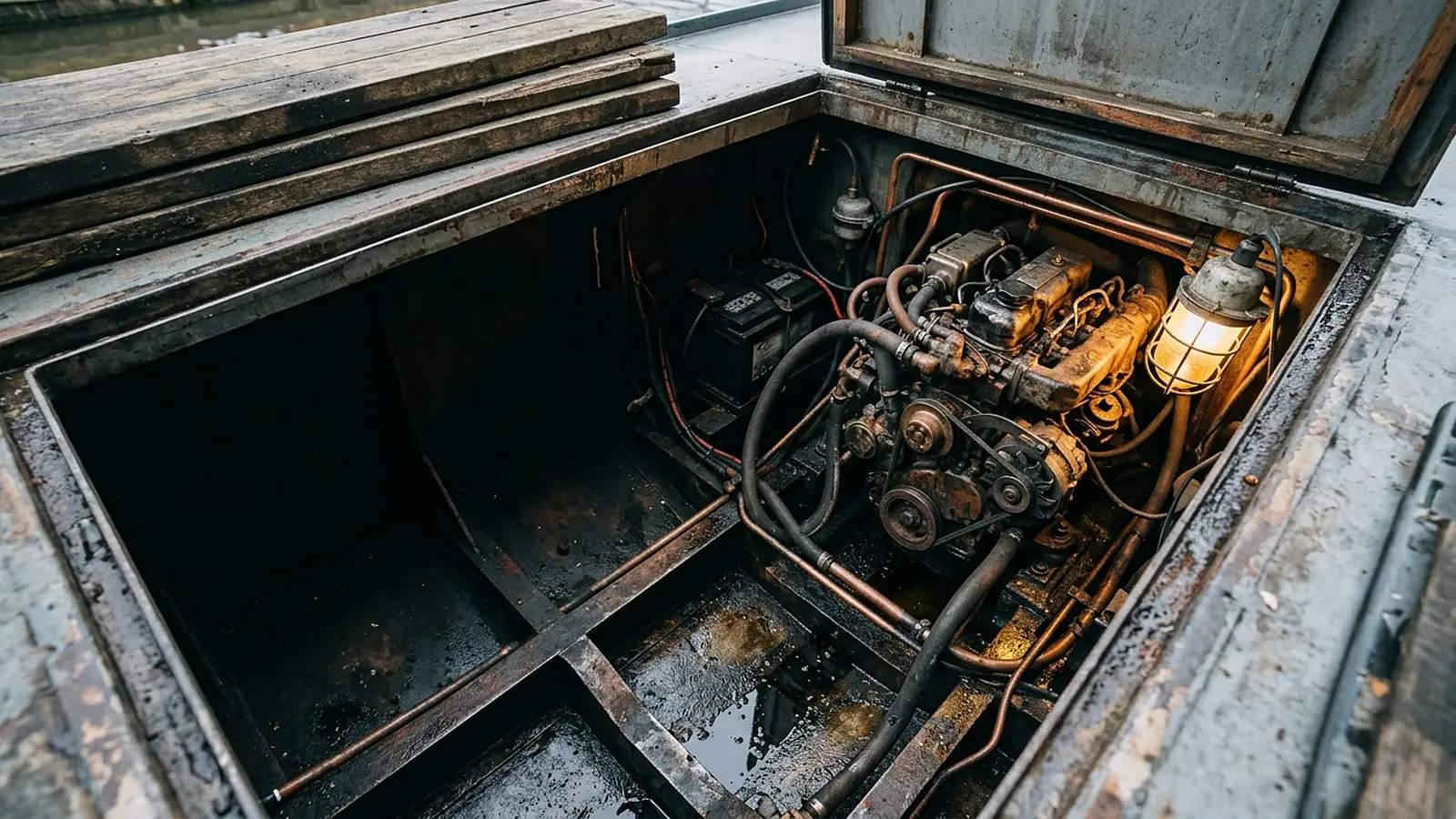
Winterising a diesel boat engine is an afternoon's work with a few cans and filters. Leave it, and spring can bring a split block, a fuel tank full of diesel bug or a battery that won't hold charge. This guide covers narrowboats, wide beams and other boats with an inboard diesel that will sit through a UK winter, whether on a home mooring, in a marina or out of the water on hard standing.
One thing up front: running the engine for five minutes every couple of weeks is not the same as looking after it. For a boat that isn't going anywhere, a proper lay-up and then leaving it alone is usually kinder to the engine. There's more on that below.
Most winter damage isn't found until the first cruise of the year. By then the boatyards are busy and the parts you need are on everyone else's list too. An afternoon with the engine hatch open now saves a lot of that.
Why winterising a diesel boat engine matters on UK waterways
Water expands when it freezes. Any passage in the engine holding plain water, or coolant that has been watered down, can crack as it does: the block, the cylinder head, the heat exchanger, the water pump body, the calorifier coil. A narrowboat moored in a frozen cut is still at risk, because the engine bay is open to the air and the cold settles there long before the canal freezes.
Frost is only part of it. Used oil left in the sump all winter carries acids from combustion. A half-empty fuel tank breathes damp air and gathers condensation. Batteries left flat in the cold lose capacity they don't get back. A proper lay-up deals with all four.
Start with how your engine is cooled
What you need to do depends on the cooling system, so check which one you have before buying anything.
- Keel-cooled. Most narrowboats, including Beta Marine and marinised BMC installations. Coolant circulates through a skin tank welded to the hull. It's a sealed circuit, so frost protection depends entirely on the antifreeze.
- Raw-water or heat exchanger cooled. Common on seagoing inboards and many sailing boats. Canal, river or sea water is pumped through the engine or its heat exchanger and out of the exhaust. That water has to be drained or replaced with antifreeze.
- Air-cooled. Lister SR and ST engines and many Lister-Petter TS and TR units have no coolant to protect, but the oil, fuel and battery steps still apply. BMC Commanders and Lister HW, HRW and JP engines are water-cooled, so they need the antifreeze steps too.
The short version
The steps are in this order for a reason: everything that needs the engine running comes before the raw-water side is drained and the impeller comes out.
- Run the engine warm and listen for anything new, then change the oil and filter and check the gearbox oil
- Test the antifreeze, or change it if it's old or unknown
- Fill the fuel tank, drain the water trap, add treatment if you use it
- Last run: protect the raw-water side, close the seacock, take the impeller out
- Charge and isolate the batteries, grease the stern gland, dry the bilge, cover the intake and exhaust
Step 1: change the oil and filter while it's warm
Run the engine until it's warm, then change the oil and filter. Fresh oil means the bearings and bores sit in clean oil for the winter rather than acidic used oil. Check the gearbox oil level and colour while you're there, and write the engine hours in the log.
Milky or creamy oil on the dipstick means water or coolant is getting in. It could be a head gasket, a cracked head, or just condensation from short runs. Either way, you've got the winter to find out, and that's better than finding out in April.
Step 2: check the antifreeze strength
On keel-cooled and heat exchanger engines, test the coolant from the header tank with an antifreeze hydrometer or refractometer, with the engine cold. Your handbook gives the mix the maker wants; many specify around 50/50 for marine use. If the coolant hasn't been changed for several years, change it even if the freezing point reads fine, because the corrosion inhibitors wear out long before the antifreeze does. Don't mix coolant types. If you don't know what's in there, drain and refill.
If the engine heats your hot water, the calorifier coil is on the same circuit. After topping up or refilling, run the engine to full temperature so the new mix gets round the calorifier and the skin tank, then bleed any air out.
Step 3: fill the fuel tank and drain the water
Fill the tank right up. Less air in the tank means less condensation, and water in diesel is what diesel bug feeds on. Modern diesel contains biodiesel, which holds water more readily than the fuel older engines were designed for.
Drain the water trap or the bowl on the primary filter until clean fuel runs out. Add a biocide or fuel treatment dosed for your tank size if you use one. Dark slime or jelly in the bowl means the tank needs cleaning, and winter is a good time to have it done.
Step 4: protect the raw-water side last
Do this after every step that needs the engine running. It's the step that matters most when winterising a marine diesel engine with raw-water cooling, and the one that gets skipped. Close the inlet seacock and clean the strainer. Then either drain the circuit using the drain points on the heat exchanger, raw-water pump and exhaust water-lock, or draw antifreeze mix through it: feed the strainer from a bucket of mix and run the engine until coloured water comes out of the exhaust. Use a non-toxic propylene glycol antifreeze for this, not the ethylene glycol in the cooling circuit, because it ends up in the water.
Many Yanmar marine diesels in sailing boats, including the GM and YM ranges, have raw water running through the engine or its heat exchanger, so this step applies to them. If you're winterizing a Yanmar diesel engine from an American manual, the steps are the same as here, and Yanmar's own lay-up instructions are worth following to the letter.
Then take the impeller out of the raw-water pump and keep it somewhere dry. Left in all winter, the rubber vanes take a set and can tear on the first start. Hang a tag on the ignition key saying "impeller out, seacock closed" so nobody starts it dry in March.
Step 5: batteries, stern gland and the engine bay
- Batteries: charge them fully. A flat lead-acid battery freezes at a far higher temperature than a charged one. Isolate them, or keep them topped up on a mains charger or solar controller.
- Stern gland: give the greaser a few turns so the packing stays sealed.
- Bilge: pump the engine bilge dry and check the bilge pump works on its float switch.
- Intake and exhaust: cover the air filter and exhaust outlet against damp and wildlife, and add that to the tag on the key.
Run it over winter, or fit a boat engine heater?
If you run the engine during the winter, run it properly: until it reaches full working temperature with some load on it, ideally by taking the boat out. Five minutes at tick-over just to "turn it over" adds condensation to the sump and exhaust without getting hot enough to drive it off. On a raw-water engine it also means refitting the impeller and opening the seacock first. If the boat isn't going anywhere, a full lay-up and leaving it alone is usually better for the engine.
On a mooring with shore power, a thermostatically controlled frost heater or tube heater in the engine bay keeps the space above freezing. Treat a boat engine heater for winter as a backup to correct antifreeze, never a replacement for it, and use only heaters made for unattended use.
Lay-up is the best time to spot a failing engine
The Step 1 warm-up run tells you a lot. While it's running, note anything that has crept in over the summer:
- Hard starting from cold, or needing more glow plug time than it used to
- White smoke that doesn't clear once warm, especially with coolant loss
- Blue smoke, heavy fumes from the breather, or oil use between top-ups
- Oil in the coolant, or coolant in the oil
- Low oil pressure when hot, or a new knock
Every one of these is cheaper to sort over winter than in spring. Winter gives you time to get a price, decide between a rebuild and a replacement, and have the work finished before the cruising season starts.
If the warm-up run turned up any of these, ring us with the engine make and model. We carry out Lister and BMC engine rebuilds in our workshop, and supply reconditioned and new narrowboat engines, from heritage units to keel-cooled Beta Marine replacements, with a 12-month warranty on reconditioned narrowboat units and delivery to your marina anywhere in the UK. If you're replacing a Lister or BMC with a Beta Marine, we'll go through engine mounts, shaft alignment, keel-cooling sizing and exhaust routing with you before delivery. For seagoing inboards, see our marine diesel engines. And if you're doing the lay-up yourself, we supply the filters, impellers, anodes and heat exchanger parts to go with it.